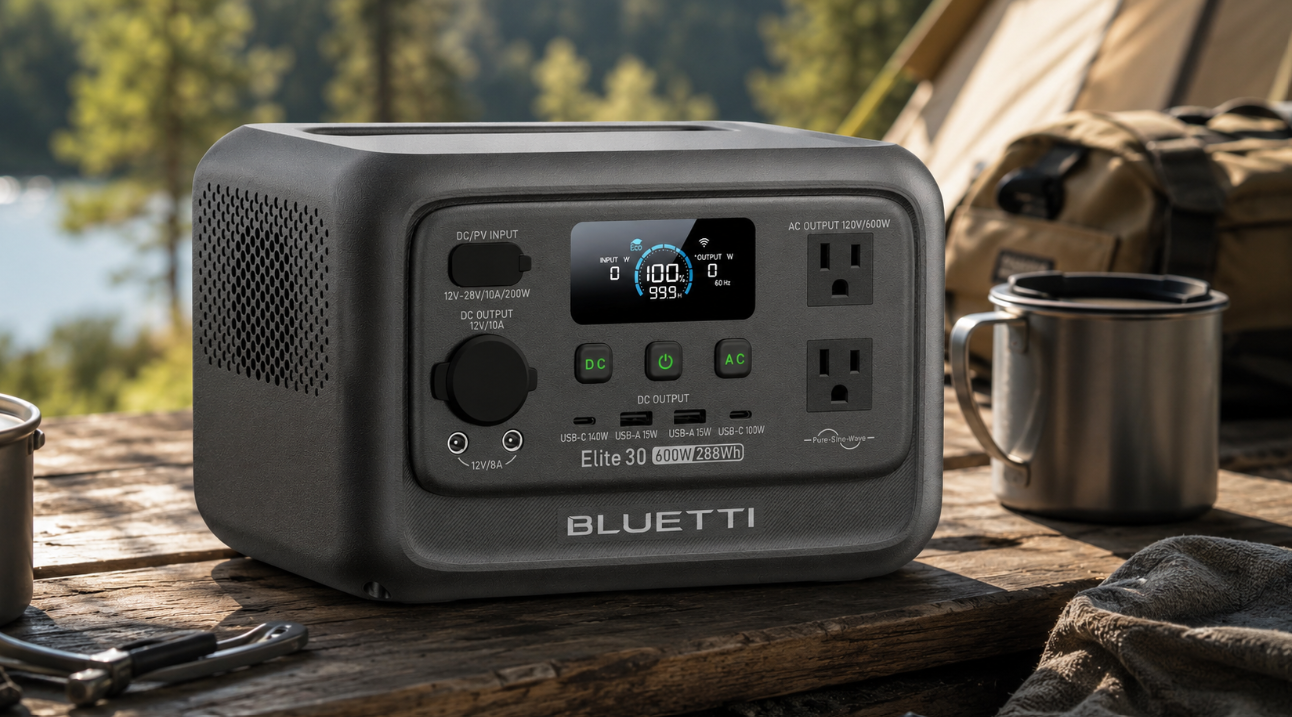
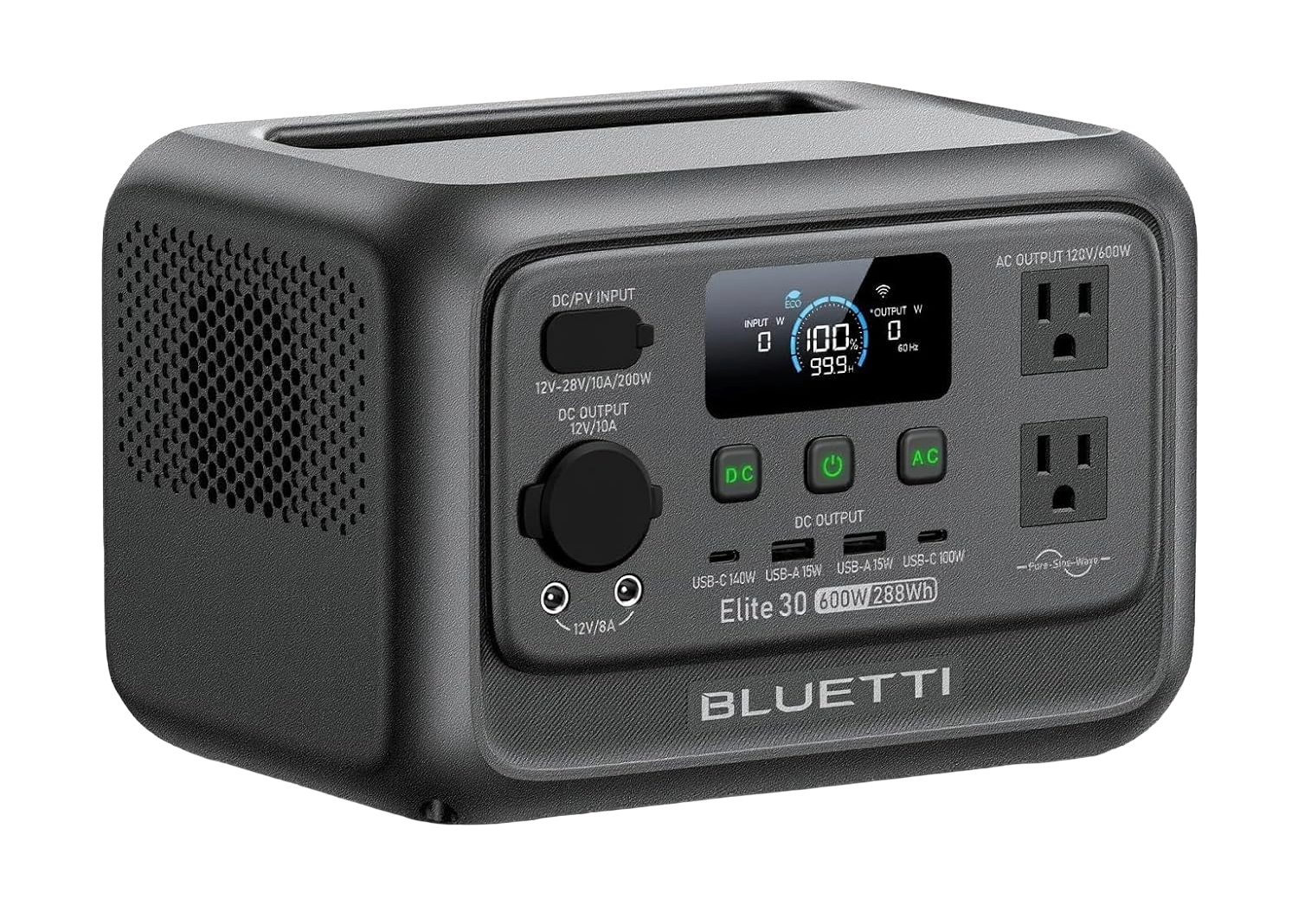
The Bluetti Elite 30 V2 answers a question most sub-$300 power stations dodge: what if a compact station could actually run appliances, not just charge devices? At 288Wh it sits in the same capacity class as the Anker SOLIX C300 and Jackery Explorer 300, but it doubles their continuous output to 600W and adds a 1500W Power Lifting surge. That single difference reshapes what this station can do.
It launched in 2025 as the successor to Bluetti’s popular EB3A, swapping the older chemistry for UltraCell LiFePO4 cells and adding a genuine 10ms UPS. The result is the rare entry-level station that punches into territory usually reserved for larger, heavier units. It is not perfect, and the 288Wh capacity sets a hard ceiling on runtime, but for the right buyer, it is one of the most capable small stations on the market in 2026.
Here is the full breakdown.
📋 In This Review
Quick Specs
| Spec | Detail |
|---|---|
| Capacity | 288Wh |
| Battery Type | LiFePO4 (UltraCell) |
| Cycle Life | 3,000+ cycles to 80% capacity |
| AC Output | 600W continuous / 1500W Power Lifting |
| USB-C Output | 140W PD 3.1 |
| Total Output Ports | 8 to 9 depending on region |
| Wall Charge Time | 45 min to 80% / 70 min full (380W turbo) |
| Solar Input | Max 200W (MPPT) |
| UPS Switchover | 10ms (980W bypass) |
| Standby Draw | 4.5W (DC 5W, AC 8W) |
| Noise Level | Under 30dB |
| Water Resistance | IP20 (none, keep dry) |
| Weight | 9.5 lbs / 4.3 kg |
| Dimensions | 9.8″ x 7″ x 6.6″ |
| Warranty | 5 years |
| Current Price | ~$219-$239 on Amazon |
Design and Build Quality
At 9.5 lbs and roughly the size of a small cooler, the Elite 30 V2 is genuinely portable for a station with this much output. The moulded top handle makes it easy to carry one-handed, and the ABS shell feels rugged enough for regular outdoor use. Bluetti ships it in six colors in the US, which is unusual for a category dominated by black and orange utility boxes. Beyond aesthetics, the build quality reads as premium for the price.
The smart cooling system keeps fan noise under 30dB even during fast charging. In practice, that means it stays quiet enough for overnight use in a bedroom or tent, with the fan only becoming noticeable during the highest output loads. The intelligent thermal management also protects the battery during the 380W turbo charge, which matters for longevity.
One design note worth knowing: in the US version, you get two 120V AC outlets, while some international versions have only one. The unit also includes a 12V car port and multiple USB-C and USB-A ports, covering most real-world output needs without adapters.
Real-World Performance
The 288Wh capacity delivers reliable runtime for device charging and light appliance use. It comfortably charges a laptop multiple times, runs a car fridge for several hours, keeps a CPAP machine going overnight, and powers lights and small electronics through a camping weekend. For its intended use cases, the capacity is well matched to the output.
Where the 288Wh shows its ceiling is sustained high-draw use. The 600W output lets you run a coffee maker, small kettle, or toaster, but only briefly: a 600W appliance drains a 288Wh battery in well under half an hour. The station is built to handle high-draw devices in short bursts, not to power them for extended periods. Understanding that distinction is the key to being happy with this unit.
For the realistic use case, powering essential and critical devices rather than running a kitchen, the Elite 30 V2 performs consistently and the UltraCell efficiency squeezes more usable runtime out of the 288Wh than older designs managed.
The 600W Advantage
This is the Elite 30 V2’s defining feature and the reason to choose it over the Anker SOLIX C300 or EcoFlow River 3. While those stations cap at 300W continuous, the Elite 30 V2 delivers a genuine 600W, twice the output, from the same capacity class.
That 600W is real, native inverter output, not a voltage trick. It means the Elite 30 V2 runs devices that would simply refuse to start on a 300W station: a full mini fridge with a higher startup surge, a CPAP with a heated humidifier, certain power tools, and a small microwave in short bursts. The 1500W Power Lifting mode extends this further for resistive loads by reducing voltage, similar to EcoFlow’s X-Boost, useful as an occasional fallback rather than a core feature.
The honest caveat from real-world testing: single high-draw resistive loads work better than running multiple high-draw devices simultaneously. The 600W is a real ceiling, and Power Lifting above it is best reserved for one device at a time.
Charging Speed
With turbo mode enabled, wall input jumps to 380W, charging the Elite 30 V2 from 0 to 80% in 45 minutes and to full in 70 minutes. That is genuinely fast for a 288Wh system and competitive with the Anker SOLIX C300’s 70-minute full charge. For a station, you might need to be ready quickly before a trip or after an outage; this is a meaningful practical advantage.
Solar input accepts up to 200W, double the EcoFlow River 3’s 110W ceiling. With a 200W panel in good sun, a full solar recharge takes under 2 hours. The MPPT controller and the app’s solar current control settings make a significant difference to real-world solar performance, so if you plan to charge off-grid, the app is essential rather than optional.
Car charging via the included XT90 to cigarette adapter runs around 100W, reliable for topping off on a road trip, though not fast. The unit supports eight charging modes total, including time-of-use scheduling for areas with peak and off-peak electricity rates.
UPS and Home Backup
The 10ms UPS is one of the Elite 30 V2’s standout features, and it performed genuinely well in independent testing. The station passes grid power straight through to connected devices until an outage occurs, then switches to battery in under 10 milliseconds, fast enough that connected electronics never notice the interruption.
This makes it a legitimate UPS for a home office setup: a desktop computer, monitor, router, and modem can all be protected from brief outages and power flickers. With 980W of bypass power, it covers a meaningful load. For anyone in an area with unreliable grid power, this single feature can justify the purchase.
The four UPS modes, Standard, Time-of-Use, PV Priority, and Custom, give real flexibility. Standard keeps the battery at 100% for backup readiness, while Time-of-Use can charge during cheap off-peak hours and discharge during expensive peak hours, a genuine money-saver in areas with variable rates.
Battery Chemistry and Efficiency
The UltraCell LiFePO4 chemistry is rated for 3,000+ charge cycles to 80% capacity, roughly 8 to 10 years of regular use. This matches the best in the sub-$300 category and decisively beats the Jackery Explorer 300’s 500-cycle lithium-ion. LiFePO4 also delivers better thermal stability, performing reliably in cold winter conditions and hot car trunks where standard lithium-ion struggles.
The UltraCell efficiency improvements cut self-consumption by up to 50% compared to older Bluetti designs. The practical result is the very low 4.5W standby draw and more usable runtime from the 288Wh capacity. Combined with the 5-year warranty, the Elite 30 V2 is built to remain useful for the better part of a decade.
Who It’s Actually For
Buy it if: You need to run appliances, not just charge devices, and the 600W native output is the reason. You want a genuine 10ms UPS for a home office or critical electronics. You value fast charging and the 45-minute-to-80% turbo mode. You want LiFePO4 longevity with the best output-to-size ratio in the category. You need solar charging up to 200W. For these uses, the Elite 30 V2 is the most capable small station in our roundup.
Skip it if: You need maximum runtime and rarely use high-draw appliances, in which case the extra output is wasted, and a cheaper 300W station serves you fine. You need long-duration or whole-home backup, where a 1,000Wh+ station is the right tool. You want the absolute lightest unit, where the EcoFlow River 3 saves nearly two pounds.
How It Compares
| Bluetti Elite 30 V2 | Anker SOLIX C300 | EcoFlow River 3 | |
|---|---|---|---|
| Capacity | 288Wh | 288Wh | 245Wh |
| AC Output | 600W | 300W | 300W |
| Surge | 1500W | 600W | 600W |
| Battery | LiFePO4 | LiFePO4 | LiFePO4 |
| USB-C Max | 140W | 140W x2 | 100W |
| Wall Charge | 45 min (80%) | 70 min | 60 min |
| Solar Input | 200W | 100W | 110W |
| UPS | 10ms | No | 30ms |
| Weight | 9.5 lbs | 8.3 lbs | 7.8 lbs |
| Warranty | 5 years | 5 years | 5 years |
| Price | ~$219-$239 | ~$169-$249 | ~$189-$239 |
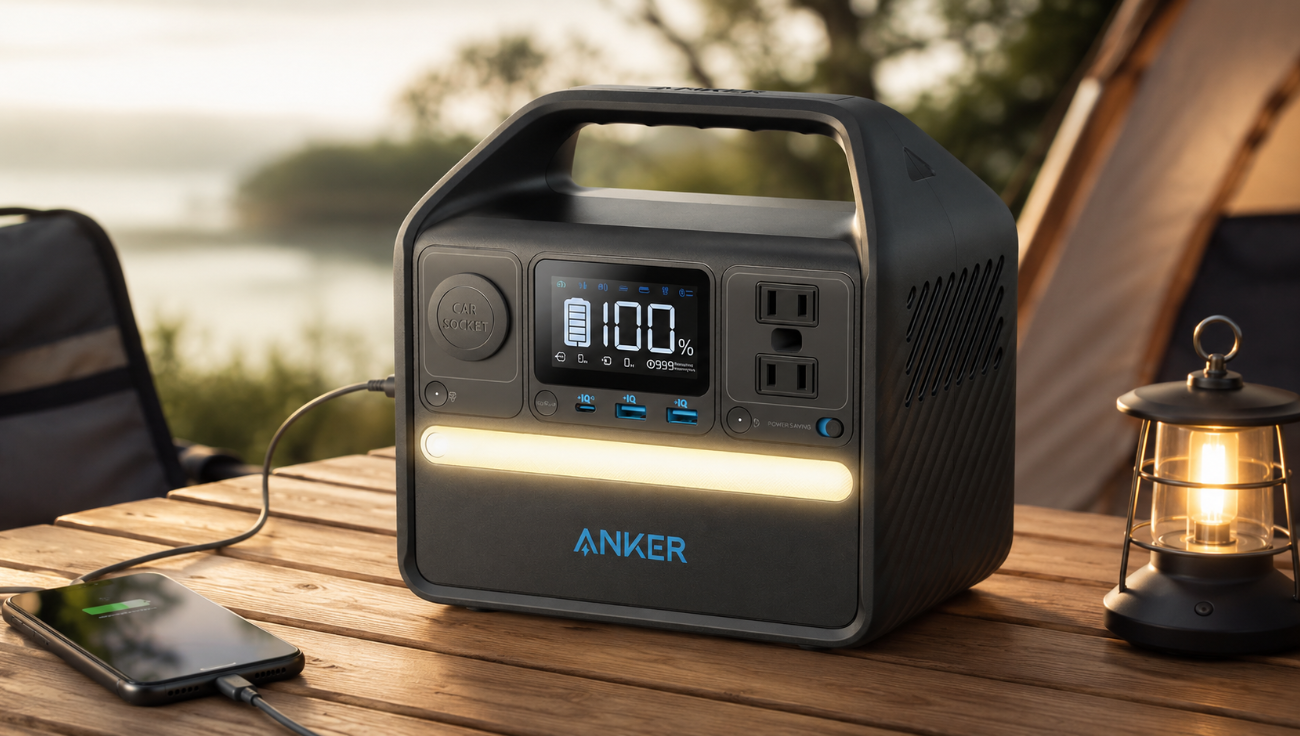
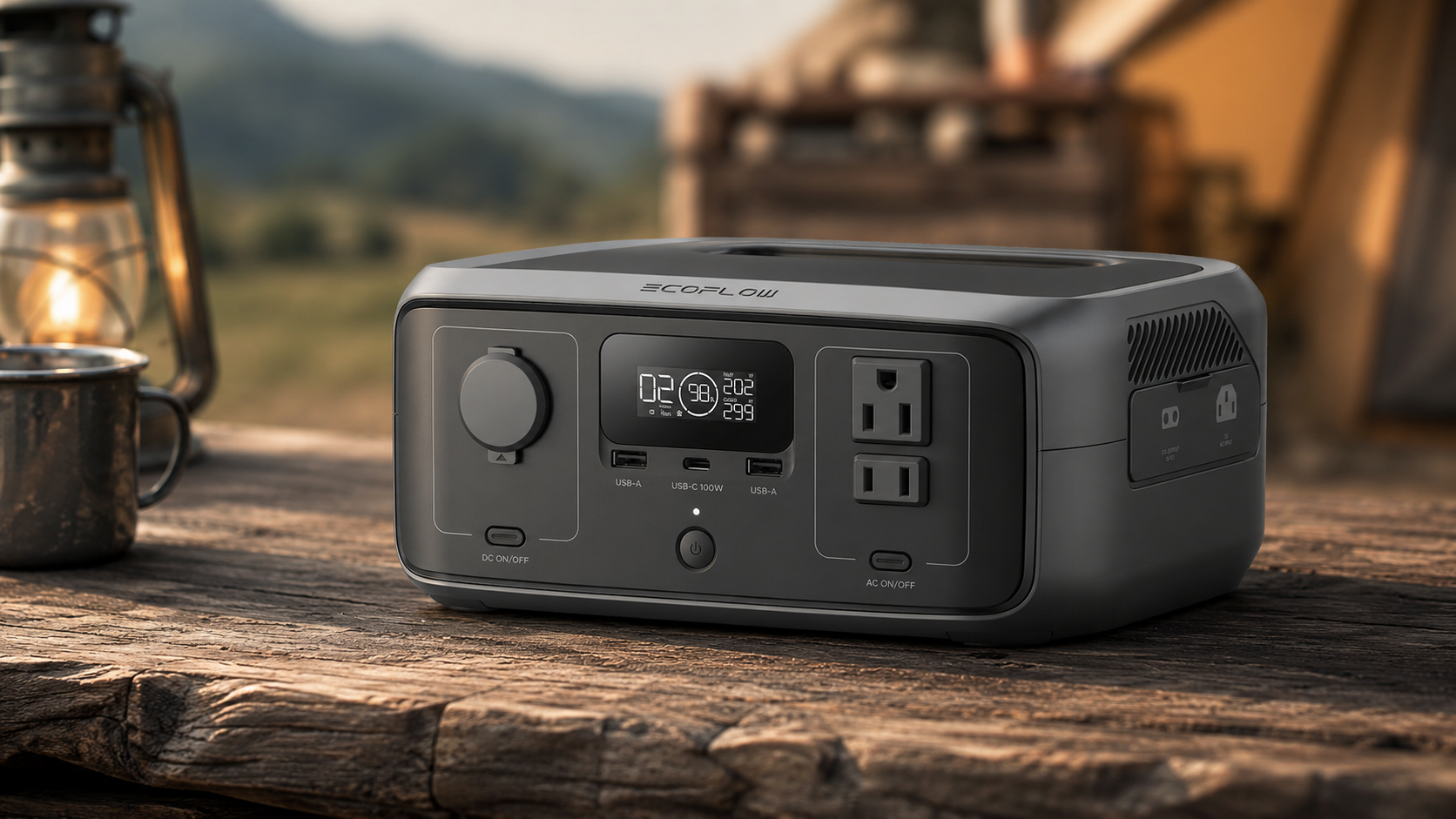
The Elite 30 V2’s case is straightforward: it wins on output (600W vs 300W), surge (1500W vs 600W), solar input (200W vs roughly 100W), and UPS speed (10ms). The Anker SOLIX C300 counters with dual 140W USB-C ports and a lighter weight, making it a better pure device-charging station. The EcoFlow River 3 is the lightest and cheapest but the least capable in terms of output. If your use case involves running appliances or a UPS duty, the Bluetti is the clear choice. If you only charge devices, the Anker’s dual USB-C and lower weight may serve you better.
Final Verdict
The Bluetti Elite 30 V2 is the most capable sub-$300 power station for anyone who needs to run appliances rather than just charge devices. The 600W native output, 1500W Power Lifting, 10ms UPS, 200W solar input, and 45-minute fast charge add up to a feature set that genuinely outclasses the 300W competition in everything except raw portability and USB-C port count.
The single limitation to understand going in is capacity. At 288Wh, this is not a long-duration backup unit. It is a high-output, fast-charging, UPS-capable station for essential devices and short appliance runs. Buy it for what it is, the most powerful small station in its class, and it delivers. At its typical $219 price, it is one of the strongest values in portable power in 2026.
✓ Pros
- 600W native output, double the competition
- 1500W Power Lifting for high-draw devices
- 10ms UPS, genuinely fast switchover
- 45 min to 80% turbo charging
- 200W solar input, highest in class
- UltraCell LiFePO4 with 4.5W standby draw
- 5-year warranty, six color options
✕ Cons
- 288Wh limits sustained appliance runtime
- Heaviest in this comparison at 9.5 lbs
- No solar cable included in the box
- IP20, no water resistance at all
- Power Lifting works best one device at a time


Leave a Reply