
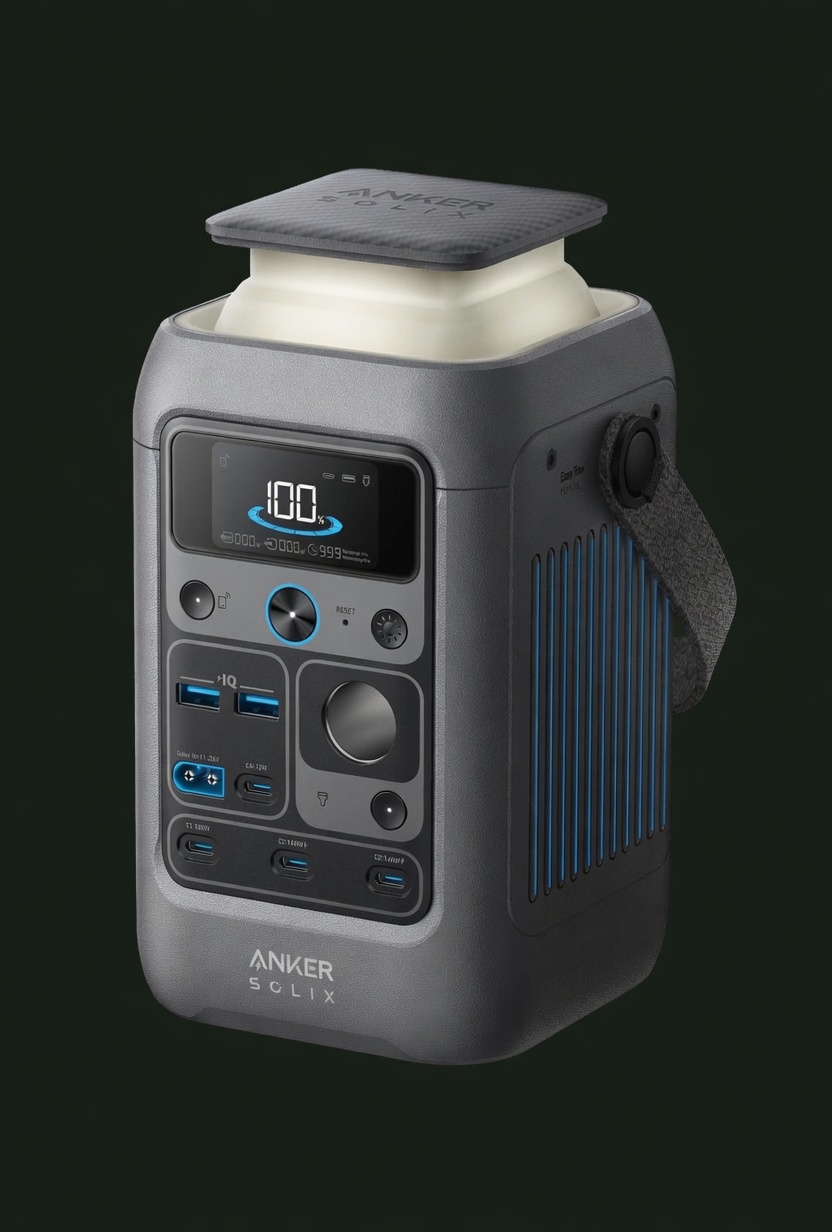
Anker built its reputation on cables and chargers. The SOLIX C300 is the clearest sign yet that the company has figured out portable power stations, too. It launched in late 2024, hit the top of the sub-$300 category almost immediately, and has stayed there since, not through marketing, but because the specs hold up against everything in its price tier on nearly every metric that matters.
That said, no station is right for everyone. The C300 has a clear profile: it is optimized for portability, fast charging, and device-level power needs. It is not a home backup workhorse. If you understand that distinction going in, the C300 is one of the most compelling purchases in the sub-$300 category in 2026. If you don’t, you’ll be disappointed when it can’t run your refrigerator.
Here is the full breakdown.
📋 In This Review
Quick Specs
| Spec | Detail |
|---|---|
| Capacity | 288Wh |
| Battery Type | LiFePO4 (InfiniPower) |
| Cycle Life | 3,000+ cycles to 80% capacity |
| AC Output | 300W continuous / 600W surge |
| USB-C Output | 2 x 140W PD (two-way) |
| USB-A Output | 2 x 22.5W |
| DC Output | 120W carport |
| AC Outlets | 2 x pure sine wave |
| Total Ports | 14 |
| Wall Charge Time | ~70 minutes (0-100%) |
| Solar Input | Max 100W (sold separately) |
| Noise Level | 25dB |
| Weight | 8.3 lbs / 3.77 kg |
| Dimensions | 9.5″ x 5.3″ x 7.2″ |
| Warranty | 5 years |
| Current Price | ~$169–$249 on Amazon |
Design and Build Quality
The C300 is noticeably smaller than it looks in photos. At 9.5 inches tall and 8.3 lbs, it fits in the footwell of a car seat, the top pocket of a large backpack, or a carry-on without reorganizing everything around it. The flat-top design with a flush integrated handle is genuinely smarter than it sounds. It makes the unit stackable, which means nothing snags in a bag, and the handle disappears when you’re not carrying it.
Build quality is consistent with Anker’s broader reputation: solid without being premium. The shell is impact-resistant plastic that feels like it can take the knocks of regular use without being babied. The port covers are firm but not frustrating to open. The LED display is clear and bright without being distracting in a dark tent.
The 25dB operating noise is one of the quietest ratings in the category, and it shows in practice. Running overnight in a bedroom during an outage, it was inaudible over normal ambient noise. Compared to older stations that hum noticeably in a quiet room, the C300 is a meaningful step forward.
Real-World Performance
The 288Wh capacity delivers close to what the math suggests once you account for the standard 85% inverter efficiency. In real-world testing, the C300 powered a laptop continuously for over 6 hours and ran a mini fridge for nearly 4 hours, numbers that align with the 86% battery efficiency recorded in independent testing.
For a typical remote work day covering a laptop, phone charging, and LED light, the C300 comfortably covers 6-8 hours of use before needing a recharge. For a camping weekend without solar, plan on one full recharge between days if you’re running a fan, laptop, and multiple device charges simultaneously.
The 600W surge rating handles most motor startup loads at this capacity level, including a small compressor fridge, a CPAP machine, and a power drill. It won’t run a full-size refrigerator or microwave, and it’s not designed to. Within its intended use case, the C300 does not have the output limitations that cause real frustration.
Charging Speed
The 70-minute wall charge is the C300’s most practically useful differentiator, and it is genuinely fast for the category. Plugging in at the start of a meeting and having a full station by the end is the kind of real-world convenience that separates this station from competitors that take 3-5 hours.
The two-way 140W USB-C charging is the other standout. While the station is charging from a wall at 140W input, you can simultaneously fast-charge a laptop through one of the USB-C output ports. Most stations at this price require you to choose between charging the station and charging your devices. The C300 handles both concurrently without issue.
Solar charging accepts up to 100W input via Anker’s compatible solar panels, sold separately. On a clear day, a full solar recharge takes approximately 3-4 hours with a 100W panel, which is practical for camping where you’re parked in the sun for most of the day. The MPPT controller optimizes the input automatically.
Ports and Outputs
14 total ports is the headline number, and it holds up in practice. The two 140W USB-C ports are the real story here. At this price tier, most stations offer one 60W USB-C port. Having two 140W ports means a MacBook Pro and a Dell XPS can both charge at rated speed simultaneously without either being throttled. For remote workers traveling with multiple high-draw devices, this is the most relevant spec on the entire sheet.
The two USB-A ports at 22.5W handle phones and smaller devices. The 120W carport covers 12V accessories and some DC-powered laptops. The two AC outlets handle standard household plugs up to 300W combined.
One minor frustration noted in owner reviews: the AC outlets are positioned close together, meaning bulkier wall adapters can block the adjacent port. Worth having an extension or power strip adapter if you plan to run two AC devices simultaneously with chunky plugs.
Battery Chemistry and Longevity
The LiFePO4 chemistry (Anker markets it as InfiniPower) is rated for 3,000+ charge cycles before dropping to 80% capacity. At one full cycle per day, that’s over 8 years of daily use. At the more realistic pace of 3-4 cycles per week for an active camper or frequent traveler, you’re looking at 15+ years before meaningful capacity degradation.
LiFePO4 also performs better in temperature extremes than standard lithium-ion. The chemistry remains stable in cold environments, whereas standard lithium-ion batteries noticeably lose capacity. For winter camping or vehicle use in cold climates, this is a real advantage.
The 5-year warranty is among the best in the sub-$300 category and reflects Anker’s confidence in the battery longevity claim. It is 2.5 times the industry standard 2-year warranty that most competitors offer at this price.
C300 vs C300 DC vs C300X: Which to Buy
Anker sells three variants of the C300, and the naming is confusing enough that it’s worth clarifying before you hit the buy button.
| Variant | AC Outlets | Key Feature | Price | Best For |
|---|---|---|---|---|
| C300 DC | No | USB and DC only, lightest | ~$149–$179 | Device charging only, maximum portability |
| C300 (standard) | Yes (2) | Full feature set, best value | ~$169–$249 | Most buyers , camping, travel, backup |
| C300X | Yes (3) | 10ms UPS, extra AC outlet | ~$249–$299 | Sensitive electronics, medical devices |
For most buyers the standard C300 is the right choice. The C300 DC makes sense if you genuinely only need USB and DC charging and want to save $30–$50. The C300X is worth the premium only if you need the 10ms UPS function for a CPAP machine, medical device, or home server that can’t tolerate even a brief power interruption.
Who It’s Actually For
Buy it if: You travel or camp regularly and want a station that handles device charging without compromise. You work remotely and need a carry-anywhere backup that can fast-charge two laptops simultaneously. You want a set-and-forget emergency backup station that will last a decade. You care about the long-term value of LiFePO4 over lithium-ion. The C300 covers all of these cases without asking you to make significant compromises.
Skip it if: You need to run high-draw appliances like a full-size fridge, microwave, or space heater. For those use cases, the 300W inverter and 288Wh capacity are both too limited. Step up to a 1,000Wh+ station. Also, skip it if budget is the primary constraint and you’ll only use it occasionally, at those use patterns, the Jackery Explorer 300 at $60–$80 less makes the financial trade-off on battery chemistry more defensible.
How It Compares
| Anker SOLIX C300 | Jackery Explorer 300 | EcoFlow River 3 | |
|---|---|---|---|
| Capacity | 288Wh | 292Wh | 245Wh |
| Battery | LiFePO4 | Lithium-ion | LiFePO4 |
| Cycle Life | 3,000+ | 500 | 3,000+ |
| Wall Charge | 70 min | 3 hrs | 60 min |
| USB-C Max | 140W x2 | 60W x1 | 60W x1 |
| AC Output | 300W | 300W | 300W |
| Surge | 600W | 500W | 600W |
| Water Resistant | No | No | IP54 |
| Noise | 25dB | ~36dB | ~30dB |
| Warranty | 5 years | 2 years | 5 years |
| Weight | 8.3 lbs | 7.1 lbs | 7.7 lbs |
| Price | ~$169–$249 | ~$179–$229 | ~$189–$229 |
The EcoFlow River 3 is the closest competition. It matches the C300 on battery chemistry, cycle life, and warranty, and beats it on water resistance (IP54) and wall charge speed (60 minutes vs 70). The C300 wins on USB-C output (140W vs 60W), noise level, and typically on price when on sale. If you camp in wet environments regularly, the River 3’s IP54 rating is a meaningful differentiator. For everything else, the C300’s dual 140W USB-C ports are a bigger practical advantage for most users.
Final Verdict
The Anker SOLIX C300 is the best-rounded sub-$300 power station available on Amazon in 2026. LiFePO4 battery chemistry, 70-minute wall charging, dual 140W USB-C ports, 25dB operation, and a 5-year warranty together make a package that is genuinely hard to fault within its intended use case.
The only meaningful limitations are the ones baked into the category: 288Wh and 300W are not enough for home backup at any serious scale. If you go in understanding that this is a device-charging and light-appliance station rather than a home backup solution, the C300 will not disappoint.
When it hits its regular sale price around $169–$199, it’s one of the clearest buys in portable power at any price tier.
✓ Pros
- LiFePO4 battery rated for 3,000+ cycles
- 70-minute full wall charge
- Dual 140W USB-C ports , best in category
- 25dB operation , genuinely quiet
- 15% smaller than comparable stations
- 5-year warranty
- Regularly drops to $169–$199 on sale
✕ Cons
- 300W inverter limits high-draw appliance use
- AC outlets close together , bulky adapters block adjacent port
- No water resistance rating
- Solar panel sold separately
- Three confusingly similar variants (C300, C300 DC, and C300X)


Leave a Reply